
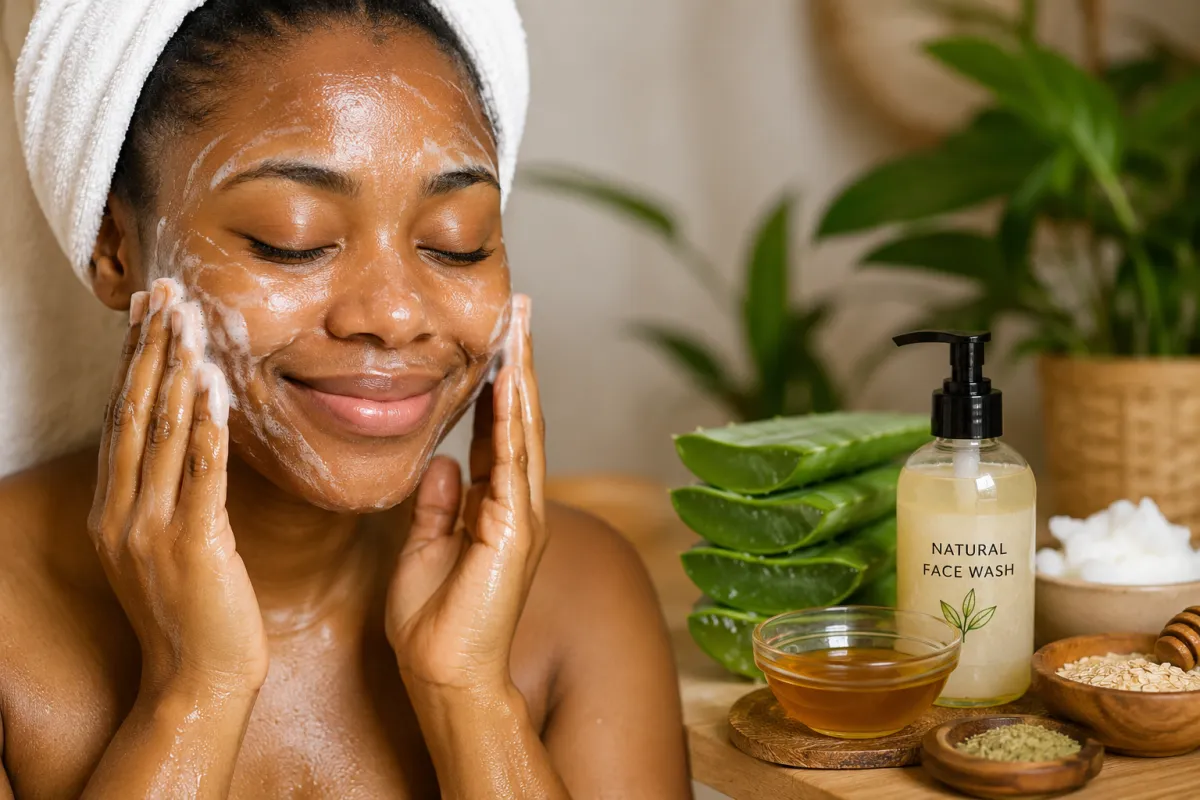
Your face is the first thing people see when they look at you. Yet most Nigerians are washing their faces daily with the same harsh soap they use on their feet, or with commercial face washes packed with chemicals that strip, irritate, and ultimately damage the skin they’re supposed to clean.
Here’s a truth most skincare brands don’t want you to know: your face deserves a dedicated, gentle cleanser formulated specifically for facial skin. Moreover, the best face wash for African skin isn’t an expensive imported product. It’s something you can make at home in 20 minutes for less than ₦1,000.
As Nigeria’s leading cosmetic raw materials supplier at Sophix Natural, we’ve helped hundreds of beauty entrepreneurs create natural face wash products that Nigerian women genuinely love. Furthermore, we’ve watched customers with persistent acne, hyperpigmentation, and chronic dryness transform their skin simply by switching to a gentle, natural facial cleanser.
Today, I’m sharing three complete natural face wash recipes specifically formulated for African skin. Additionally, I’ll cover exactly which ingredients work best for our unique skin concerns, how to troubleshoot common problems, and how to build a profitable facial skincare business from these recipes.
Let’s get into it.
Why Commercial Face Washes Are Failing African Skin
Before diving into the natural face wash recipes, let’s understand exactly what’s wrong with most commercial options.
Facial skin is significantly more sensitive and delicate than body skin. Specifically, it’s thinner, has more sebaceous glands, and is constantly exposed to environmental stressors. Consequently, harsh cleansers that might be tolerable on body skin cause real, measurable damage when used on the face daily.
The biggest culprit is again SLS and SLES. According to research published on PubMed, these surfactants increase facial skin permeability by up to 40% with repeated use. As a result, skin becomes increasingly sensitive, reactive, and unable to retain moisture effectively over time.
Additionally, most commercial face washes have a pH of 7-8, which is far too alkaline for facial skin. The ideal facial skin pH is 4.5-5.5. Consequently, using a product with the wrong pH disrupts the acid mantle, which is your skin’s natural protective barrier. Furthermore, a disrupted acid mantle allows bacteria to multiply more easily, which is one reason commercial face wash users often experience more acne rather than less.
For African skin specifically, the additional concern is post-inflammatory hyperpigmentation. Any cleanser that causes irritation or disrupts the skin barrier can trigger dark spots. Therefore, choosing a gentle, pH-appropriate cleanser is directly related to managing hyperpigmentation on Nigerian skin.
What Makes a Great Natural Face Wash for African Skin
Understanding the components of effective natural face wash formulation helps you create products that work professionally and safely on facial skin.
The Facial Cleanser (Gentler Than Body Wash)
Facial cleansers need to be significantly milder than body wash. Specifically, the surfactant concentration should be lower and the type of surfactant used should be the gentlest available.
Cocamidopropyl Betaine: Works excellently as a mild facial cleanser when used at lower concentrations than in body wash. Furthermore, its amphoteric nature means it’s compatible with all skin types and pH ranges.
Decyl Glucoside: Even milder than Cocamidopropyl Betaine, making it ideal for sensitive, acne-prone, or reactive facial skin. Additionally, it’s derived entirely from plants (coconut and corn) and has an excellent safety profile.
Combination approach: Using both surfactants together creates a mild, effective cleansing system. Consequently, you get thorough cleansing without the irritation risk of more aggressive surfactants.
The Skin-Soothing Agents
Facial skin needs soothing ingredients that calm any irritation from cleansing and prepare skin for subsequent skincare steps.
Aloe vera juice: Provides immediate soothing, anti-inflammatory benefits. Additionally, its enzymes gently exfoliate the skin surface during cleansing. Furthermore, it helps maintain skin hydration throughout the cleansing process.
Vegetable glycerine: Attracts moisture to skin even during washing. Consequently, skin feels hydrated rather than stripped after cleansing.
The Active Ingredients (What Makes Each Recipe Special)
Different skin concerns need different active ingredients in the cleanser:
For brightening: Niacinamide, vitamin C, licorice extract, kojic acid
For acne: Tea tree oil, salicylic acid, neem extract
For sensitive skin: Chamomile extract, calendula, lavender essential oil
For anti-aging: Green tea extract, vitamin E
The pH
This cannot be overemphasized. Natural face wash must be pH 4.5-5.5. According to the International Journal of Cosmetic Science, maintaining correct facial pH is one of the most important factors in preventing acne, eczema, and premature aging. Therefore, always test and adjust pH before bottling.
What You’ll Need
Basic Ingredients for All Recipes:
Primary Cleansers:
- Cocamidopropyl Betaine (Coco Betaine) – Gentle facial cleanser
Soothing and Moisturizing Agents:
- Vegetable Glycerine – Essential humectant
- Sweet Almond Oil – Lightweight facial oil
- Aloe Vera Juice – Soothing base
Additional Essentials:
- Distilled or de-ionized water
- Preservative (Germall Plus)
- Essential oils of choice
- Citric acid (pH adjustment)
- pH strips or digital pH meter
- Salt (sodium chloride) – for thickening
Equipment:
- Digital kitchen scale
- Mixing bowls
- Spatula
- pH strips
- Clean pump or foaming bottles
- Labels
- 70% isopropyl alcohol
Total cost: Approximately ₦1,200-₦1,800 to make 250ml of premium natural face wash
Recipe 1: Natural Face Wash Gentle Formula (All Skin Types)
This is your foundation recipe designed to work beautifully for all Nigerian skin types. Furthermore, it’s mild enough for daily use twice a day without causing irritation or dryness.
Makes: 250ml
Ingredients by Weight:
Water Phase:
- Distilled water – 140g (56%)
- Aloe Vera Juice – 30g (12%)
- Vegetable Glycerine – 10g (4%)
Surfactant Phase:
- Cocamidopropyl Betaine – 60g (24%)
Oil Phase:
- Sweet Almond Oil – 3g (1.2%)
Cool Down Phase:
- Salt – 3g (1.2%)
- Preservative (Germall Plus) – 1g (0.5%)
- Essential oils – 8-10 drops
- Citric acid solution (pH adjustment)
Total: 250g
Cost breakdown: Approximately ₦700-₦900 for 250ml
Step-by-Step Instructions:
Step 1: Sanitize All Equipment (5 minutes)
Spray every piece of equipment with 70% isopropyl alcohol and allow to air dry completely. This step is even more critical for face wash than body wash because facial skin is more susceptible to infection from contaminated products. Furthermore, measure and weigh all ingredients before starting.
Step 2: Combine Water Phase Ingredients (3 minutes)
In your mixing bowl, combine distilled water, aloe vera juice, and vegetable glycerine. Stir gently until fully combined. Additionally, the aloe vera juice may be slightly thicker than water, so stir until the mixture is completely uniform.
Step 3: Add Cocamidopropyl Betaine (3 minutes)
This is the most critical step for natural face wash quality. Slowly pour Cocamidopropyl Betaine into the water phase mixture. Stir with a spatula using very gentle, slow circular motions.
Critical reminder: Stir SLOWLY and deliberately. Fast mixing creates excessive foam and air bubbles that are very difficult to remove from the finished product. Consequently, stir for 2-3 minutes until the mixture is completely smooth and slightly thickened.
Notice: The face wash surfactant concentration (24%) is lower than body wash (26-28%). This is intentional because facial skin needs gentler cleansing than body skin.
Step 4: Add Sweet Almond Oil (2 minutes)
Add sweet almond oil very slowly while stirring continuously. The surfactant helps incorporate this small amount of oil smoothly. Furthermore, sweet almond oil at 1-2% provides excellent skin conditioning for facial skin without making the formula greasy or causing breakouts.
Step 5: Add Salt for Thickening (3 minutes)
Add salt gradually, 0.5g at a time, stirring after each addition. The target consistency for face wash is slightly thinner than body wash. Specifically, it should pour easily but not be completely watery.
Consistency target: Flows freely but has some body. Think of the consistency of a light syrup rather than the thick honey consistency of body wash. Consequently, face wash needs to be thinner because you apply it directly to facial skin rather than through a loofah.
Step 6: Add Preservative and Essential Oils (2 minutes)
Add preservative and essential oils. Stir gently but thoroughly.
Best essential oils for facial use:
Lavender (6 drops) – Most versatile, suitable for all skin types, calming
Frankincense (5 drops) – Anti-aging, skin tone evening, deeply soothing
Geranium (4 drops) – Balances oil production, suitable for combination skin
Chamomile (4 drops) – Ultra-soothing, ideal for sensitive or reactive skin
Rose (4 drops) – Hydrating, brightening, luxurious scent
Avoid citrus essential oils in facial products used during the day because they can cause photosensitivity and increase dark spot formation.
Step 7: Test and Adjust pH (5 minutes)
Test pH rigorously. For natural face wash, the target pH is 4.5-5.5. This is slightly more specific than body wash because facial pH balance has a direct impact on acne, sensitivity, and hyperpigmentation.
Testing method: Dip a pH strip into the face wash. Compare the color change to the reference chart. Specifically, test 3-4 times and average the readings for accuracy.
If pH is above 5.5: Add citric acid solution drop by drop. Stir thoroughly between additions. Retest after each addition.
If pH is below 4.5: Add baking soda solution one drop at a time. Stir and retest.
Step 8: Bottle and Label (5 minutes)
Transfer to clean pump or foaming bottles. Foaming pump bottles are particularly popular for face wash because they create a rich foam that’s easy to apply without needing to create lather in your hands first. Furthermore, they look premium and are highly hygienic.
Shelf life: 3-6 months with proper preservation.
Total making time: 25-30 minutes
Recipe 2: Natural Face Wash Brightening Formula (For Dark Spots and Uneven Tone)
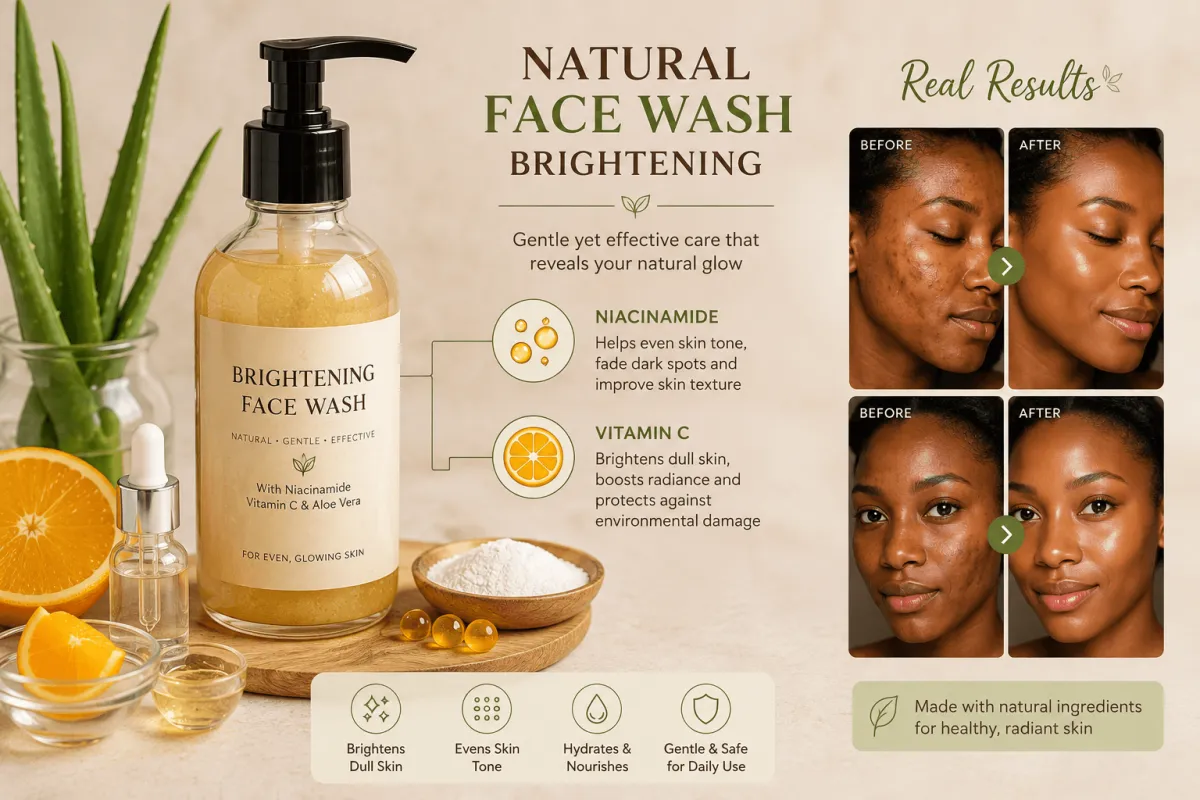
This recipe builds on the basic formula by adding targeted brightening ingredients. Consequently, it’s specifically designed for the hyperpigmentation and uneven skin tone concerns that affect most Nigerian women.
Makes: 250ml
Ingredients by Weight:
Water Phase:
- Distilled water – 120g (48%)
- Aloe Vera Juice – 35g (14%)
- Vegetable Glycerine – 10g (4%)
- Niacinamide – 5g (2%)
Surfactant Phase:
- Cocamidopropyl Betaine – 65g (26%)
Oil Phase:
- Sweet Almond Oil – 3g (1.2%)
Cool Down Phase:
- Salt – 3g (1.2%)
- Preservative – 1g (0.5%)
- Frankincense Essential Oil – 5 drops
- Lavender Essential Oil – 5 drops
- Citric acid solution (pH adjustment)
Total: 250g
What Makes This Recipe Different and More Powerful:
Niacinamide (Vitamin B3) is the star brightening ingredient in this formula. Specifically, at 2% concentration it inhibits melanin transfer from pigment-producing cells to skin surface cells. Consequently, existing dark spots fade gradually and new ones form more slowly with consistent use.
Additionally, niacinamide strengthens the skin barrier, reduces inflammation, and minimizes pores. Therefore, this recipe addresses multiple Nigerian skin concerns simultaneously in a single daily cleansing step.
Higher aloe vera concentration provides extra soothing to counterbalance the slightly higher surfactant concentration. Furthermore, it adds natural brightening compounds from the aloe plant itself.
Special Instructions for Recipe 2:
Add niacinamide to the water phase before adding the surfactant. Specifically, stir niacinamide into the water-aloe-glycerine mixture until completely dissolved. It dissolves easily at room temperature. Consequently, there’s no need for heating in this recipe.
Everything else follows exactly the same steps as Recipe 1.
Important pH note: Niacinamide is most effective at pH 5.0-7.0. Therefore, aim for pH 5.0-5.5 in this recipe to satisfy both skin compatibility and niacinamide effectiveness simultaneously.
Expected Results with Consistent Use:
Weeks 1-2: Skin feels cleaner and more comfortable after washing. Additionally, overall skin tone appears slightly more even.
Weeks 3-4: Existing dark spots begin to appear lighter around the edges. Furthermore, new spots from breakouts or irritation fade significantly faster.
Weeks 6-8: Noticeable overall brightening and more even skin tone. Consequently, you may find you need less makeup to achieve even coverage.
Weeks 10-12: Significant improvement in hyperpigmentation. Moreover, skin texture is visibly smoother and more refined.
Recipe 3: Natural Face Wash Acne-Fighting Formula (For Oily and Acne-Prone Skin)
This specialized formula is designed for the millions of Nigerian women dealing with persistent acne, clogged pores, and excess oil production. Furthermore, it’s particularly effective for the type of acne triggered by our hot, humid climate.
Makes: 250ml
Ingredients by Weight:
Water Phase:
- Distilled water – 130g (52%)
- Aloe Vera Juice – 35g (14%)
- Vegetable Glycerine – 8g (3.2%)
- Niacinamide – 5g (2%)
Surfactant Phase:
- Cocamidopropyl Betaine – 65g (26%)
Cool Down Phase:
- Salt – 3g (1.2%)
- Preservative – 1g (0.5%)
- Tea Tree Essential Oil – 10 drops
- Lavender Essential Oil – 5 drops
- Citric acid (pH adjustment)
Total: 250g
What Makes This Recipe Specifically Effective for Acne:
No oil in this formula. Unlike the other two recipes, the acne-fighting formula contains no sweet almond oil. Consequently, it provides thorough cleansing without adding any oil to already oily skin.
Tea tree essential oil contains terpinen-4-ol, which has clinically proven antimicrobial activity against Propionibacterium acnes, the primary bacteria responsible for acne. Furthermore, it reduces inflammation from existing breakouts while preventing new ones from forming.
Niacinamide at 2% regulates sebum production. As a result, skin produces less excess oil throughout the day, reducing the environment that causes acne in the first place.
Higher aloe vera concentration soothes the inflammation and redness associated with active breakouts. Additionally, aloe’s natural salicin content provides mild exfoliation that helps keep pores clear without harsh physical scrubbing.
Special Instructions for Recipe 3:
Follow Recipe 1 instructions exactly, with these modifications:
Omit sweet almond oil entirely. Additionally, add niacinamide to the water phase as described in Recipe 2. Everything else remains the same.
pH target for acne skin: Aim for pH 4.5-5.0. Slightly more acidic than the other formulas. Consequently, this lower pH is more hostile to acne-causing bacteria while still being gentle on facial skin.
Natural Face Wash for Different Nigerian Skin Types
For Dry Facial Skin
Dry facial skin needs maximum gentleness and moisture retention during cleansing. Therefore, use Recipe 1 (gentle formula) and increase glycerine to 15g. Additionally, increase sweet almond oil to 5g for extra conditioning. Furthermore, wash with lukewarm (never hot) water and limit cleansing to once daily in the evening only.
Application tip: Apply face wash with your fingertips using the lightest possible pressure. Specifically, let the gentle surfactants do the work rather than scrubbing. Rinse thoroughly and pat dry immediately with a soft cloth.
For Oily Facial Skin
Oily skin needs thorough cleansing without stripping. Consequently, use Recipe 3 (acne-fighting) as your primary formula. Additionally, cleanse twice daily (morning and evening) but avoid the temptation to cleanse more frequently. Over-cleansing triggers increased oil production. Furthermore, use slightly cooler water than usual because heat stimulates sebum production.
Application tip: Massage face wash into skin for a full 60 seconds before rinsing. This additional contact time allows the tea tree and niacinamide to penetrate more effectively. Moreover, rinse thoroughly to remove all traces of face wash that could clog pores.
For Combination Skin
Combination skin needs balanced cleansing that addresses both dry and oily areas without over-treating either. Therefore, use Recipe 1 (gentle formula) as your foundation. Additionally, apply a slightly larger amount to the T-zone (forehead, nose, chin) where oiliness is most pronounced, and less to the cheeks where dryness is more common.
For Sensitive Facial Skin
Sensitive skin needs the most careful approach. Consequently, use Recipe 1 with chamomile essential oil exclusively and avoid any recipe containing tea tree or citrus oils. Additionally, reduce surfactant concentration by 5g and increase water by 5g for an even gentler cleanse.
Application tip: Perform a patch test by applying the face wash to your inner wrist for 24 hours before using it on your face. Furthermore, introduce the product gradually, using it once daily for the first week before increasing to twice daily.
For Mature or Aging Facial Skin
Mature skin needs gentle cleansing that doesn’t strip the natural oils that become increasingly important as skin ages. Therefore, use Recipe 1 with frankincense essential oil for its proven anti-aging benefits. Additionally, increase sweet almond oil to 4g for extra conditioning.
Application tip: Always follow with a rich facial moisturizer immediately after cleansing. Mature skin loses moisture rapidly after washing. Consequently, the sooner you apply moisturizer, the better your skin will respond.
How to Use Natural Face Wash Correctly
Using face wash correctly is just as important as the formula itself. Here’s exactly how to get the best results from your natural face wash.
Morning Routine:
Step 1: Wet your face with lukewarm water. Splash water generously to ensure the entire face is damp.
Step 2: Dispense a small amount of face wash (about half a teaspoon) into your palm. Then, rub hands together to create a light lather.
Step 3: Apply to your face using gentle circular motions with your fingertips. Specifically, work from the center of your face outward. Furthermore, spend extra time on areas prone to congestion like the nose and chin.
Step 4: Massage for 30-60 seconds. This contact time allows the active ingredients to work effectively on your skin.
Step 5: Rinse thoroughly with cool water. Ensure no face wash residue remains, particularly around the hairline and jaw area where buildup often occurs.
Step 6: Pat dry with a clean, soft cloth. Never rub aggressively.
Step 7: Apply your toner, serum, and moisturizer immediately while skin is still slightly damp.
Evening Routine:
The evening cleanse is the most important of the day. Specifically, you’re removing a full day of sunscreen, makeup, pollution, and excess sebum.
Double cleanse if wearing makeup or sunscreen. First, use a cleansing oil or micellar water to remove makeup and sunscreen. Then, follow with your natural face wash for a thorough second cleanse. Consequently, this two-step approach ensures completely clean skin before your nighttime skincare.
Spend more time massaging in the evening cleanse. Specifically, 60-90 seconds of gentle massage stimulates circulation and allows the active ingredients more time to work.
Troubleshooting Your Natural Face Wash
Problem: Face wash is too runny
Why: Insufficient salt or the salt curve effect hasn’t kicked in yet.
Fix: Add salt 0.5g at a time, stirring and testing after each addition. Furthermore, remember that face wash should be thinner than body wash by design.
Problem: Face feels tight or dry after washing
Why: pH is too high, surfactant concentration is too high, or skin needs time to adjust.
Fix: Recheck and lower pH to 4.5-5.5. Additionally, reduce surfactant by 5g and increase water accordingly. Furthermore, give skin 2 weeks to adjust if switching from a different cleanser.
Problem: Face wash is causing breakouts
Why: pH is incorrect, face wash is not being rinsed off completely, or a specific ingredient doesn’t suit your skin.
Fix: Test and correct pH immediately. Additionally, ensure you’re rinsing for at least 30 seconds. Furthermore, patch test each ingredient individually to identify the specific cause.
Problem: Niacinamide isn’t dissolving
Why: Water temperature might be too cold or stirring was insufficient.
Fix: Warm water slightly (to about 30-35°C) and stir niacinamide for a full minute until completely clear. Consequently, you’ll have no visible powder particles in the finished product.
Problem: Essential oils aren’t incorporating smoothly
Why: Essential oils were added before surfactant or in too large a quantity.
Fix: Always add essential oils in the cool down phase after the surfactant is fully incorporated. Additionally, add drops one at a time while stirring continuously.
Problem: Face wash separates after a few days
Why: Oil percentage is too high for the surfactant concentration, or temperature changes are causing separation.
Fix: Reduce sweet almond oil to 2g in future batches. Furthermore, store in a cool, stable temperature location away from heat sources.
Packaging Your Natural Face Wash for Selling
Natural face wash is one of the most profitable products in any Nigerian beauty brand’s lineup. Here’s how to position and price it for maximum success.
Container Options:
Foaming pump bottles (100-150ml): The most popular choice for face wash. Specifically, the foaming pump creates a rich foam that customers associate with premium products. Consequently, these bottles command the highest retail prices.
Regular pump bottles (100-200ml): Professional and practical. Furthermore, they’re more affordable than foaming pumps while maintaining a premium appearance.
Tube packaging (100ml): Travel-friendly and popular with younger customers. Additionally, tubes are hygienic because they prevent air from entering and contaminating the product.
Labeling Your Natural Face Wash:
Essential label information:
- Product name and skin type suitability
- Full INCI ingredient list in descending order
- Net volume
- Manufacturing date and batch number
- pH level (customers love seeing this)
- “Sulfate-Free” and “Paraben-Free” claims
- Usage instructions
- Your brand contact information
Power claims for marketing:
- “Formulated for African skin”
- “pH-balanced for Nigerian climate”
- “With Niacinamide for dark spot fading” (Recipe 2)
- “Tea tree for acne-prone skin” (Recipe 3)
Pricing Your Natural Face Wash:
Cost breakdown per 150ml foaming bottle:
- Ingredients: ₦600-₦800
- Foaming bottle and label: ₦400-₦600
- Total cost: ₦1,000-₦1,400
Recommended retail prices:
- Basic gentle formula: ₦3,000-₦4,000 per 150ml
- Brightening formula with niacinamide: ₦4,000-₦5,500 per 150ml
- Acne-fighting formula: ₦3,500-₦5,000 per 150ml
Profit per bottle: ₦1,600-₦4,100 depending on recipe and positioning
Scale example: Sell 25 brightening formula bottles monthly at ₦5,000 each = ₦125,000 revenue, approximately ₦90,000 profit from face wash alone!
Building Your Complete Natural Skincare Range:
With your natural body wash, face wash, and upcoming face cream recipes, you’re building a complete skincare range that customers can use from head to toe. Consequently, one loyal customer can generate ₦15,000-₦25,000 in monthly revenue across your entire product line.
Complete natural skincare bundle:
- Natural Face Wash (₦4,500)
- Natural Face Cream (coming soon!)
- Natural Body Wash (₦4,000)
- Natural Body Scrub (₦2,500)
- Natural Body Butter (₦4,000)
Bundle price: ₦18,000 (saving ₦1,500)
Your Action Plan: Make Your First Batch This Weekend
You now have three complete natural face wash recipes covering every Nigerian skin concern. Here’s exactly what to do.
First, identify your primary skin concern: Is it dryness, dark spots, or acne? Choose the recipe that directly addresses your biggest concern.
Second, gather ingredients from a quality supplier. Specifically, Cocamidopropyl Betaine and Vegetable Glycerine are your two most essential purchases.
Third, invest in pH strips or a digital pH meter. This is non-negotiable for facial products. Specifically, incorrect pH in a face wash causes more skin problems than it solves.
Fourth, start with Recipe 1 (gentle formula) to master the basic technique. Then, move to Recipes 2 or 3 once you’re confident with the process.
Finally, commit to using your natural face wash consistently for 8 weeks before evaluating results. Take weekly photos in the same lighting to track real improvement.
Ready to start? Get your quality ingredients:
- Cocamidopropyl Betaine (Coco Betaine) – Your gentle facial cleansing ingredient
- Vegetable Glycerine – Essential daily moisture retention
- Sweet Almond Oil – Lightweight facial conditioning oil
Have you tried making natural face wash at home before? What ingredients worked best for your skin type? Share your experience in the comments below. Our community of 5,000+ Nigerian beauty enthusiasts would love to hear from you and learn from your skincare journey!