
Pick up your current body wash and read the ingredients list. Chances are you’ll find Sodium Laureth Sulfate, synthetic fragrances, parabens, and a long list of chemical preservatives you’ve never heard of. Moreover, these ingredients are in a product you apply to your entire body every single day.
Here’s what most people don’t realize: your skin absorbs a significant portion of everything you put on it. Consequently, the harsh chemicals in commercial body wash don’t just sit on your skin surface. They penetrate, accumulate, and over time contribute to skin sensitivity, dryness, and irritation that most Nigerians simply accept as normal.
But what if your daily shower could actually nourish your skin instead of stripping it? As Nigeria’s leading cosmetic raw materials supplier at Sophix Natural, we’ve helped hundreds of beauty entrepreneurs create natural body wash products that customers love. Furthermore, we’ve watched Nigerian women transform their skin simply by switching from commercial to homemade natural body wash.
Today, I’m sharing three complete natural body wash recipes covering basic moisturizing, luxury shea butter, and antibacterial formulas. Additionally, I’ll cover exactly which ingredients work best for Nigerian skin, how to troubleshoot common problems, and how to build a profitable business from this product.
Let’s get into it.
Why Commercial Body Wash Is Damaging Nigerian Skin
Before jumping into the natural body wash recipes, let’s understand exactly what we’re replacing and why it matters.
The primary concern with most commercial body washes is Sodium Laureth Sulfate (SLES) and its more aggressive cousin Sodium Lauryl Sulfate (SLS). These are cheap, effective foaming agents that create the rich lather most people associate with feeling clean. However, their effectiveness comes at a significant cost.
According to research published on PubMed, repeated SLS exposure significantly disrupts the skin barrier, increasing transepidermal water loss and triggering inflammation. For Nigerian skin that already deals with environmental stressors like dust, sun, and humidity, this additional barrier damage creates a cycle of chronic dryness and sensitivity.
Furthermore, commercial body washes contain synthetic fragrances, which are among the most common causes of contact dermatitis according to the American Academy of Dermatology. Specifically, the term “fragrance” on an ingredient list can represent a blend of up to 200 different synthetic chemicals, none of which need to be individually disclosed.
Additionally, many commercial body washes contain parabens (methylparaben, propylparaben) as preservatives. While regulatory bodies consider current exposure levels safe, many consumers prefer to avoid them entirely, particularly during pregnancy and for sensitive skin conditions.
The solution is a natural body wash that cleanses effectively using mild, skin-friendly surfactants while adding genuine moisturizing benefits your skin actually needs.
What Makes a Great Natural Body Wash
Understanding the components of effective natural body wash formulation helps you create products that work professionally. Consequently, you’ll be able to customize recipes confidently and troubleshoot problems when they arise.
The Cleansing Agent
This is the foundation of any body wash. Specifically, it determines how effectively the product removes dirt and oil while being gentle on skin.
Cocamidopropyl Betaine (Coco Betaine): Your primary cleanser for natural body wash. Derived from coconut oil, it’s mild, effective, and produces a pleasant creamy lather. Furthermore, it’s an excellent choice for Nigerian skin because it cleanses without stripping the skin barrier aggressively. Additionally, it acts as a conditioning agent, leaving skin soft after rinsing.
Decyl Glucoside: A plant-derived surfactant made from coconut and corn. It’s one of the mildest cleansers available and is suitable for the most sensitive skin types. Consequently, it’s particularly valuable in formulations for babies or people with eczema.
The Moisturizing Agents
These keep skin hydrated during and after cleansing, preventing the tight, dry feeling that commercial body washes often leave.
Vegetable Glycerine: Acts as a humectant that attracts moisture to skin while you shower. Furthermore, it stays on skin after rinsing, providing ongoing hydration throughout the day.
Natural oils: Small amounts of conditioning oils like coconut oil and sweet almond oil provide emollient benefits, leaving skin visibly softer after washing.
The Thickener
Body wash needs to be thick enough to dispense properly from a bottle without being so thick it doesn’t pour. Salt (sodium chloride) is the most effective and affordable thickener for surfactant-based formulations.
The Preservative
Any water-containing product needs a broad-spectrum preservative. Therefore, this is completely non-negotiable from both safety and legal perspectives.
The Extras
Essential oils for fragrance, botanical extracts for specific benefits, and active ingredients for targeted concerns like brightening or antibacterial protection.
What You’ll Need
Basic Ingredients for All Recipes:
Primary Cleanser:
- Cocamidopropyl Betaine (Coco Betaine) – Your star cleansing ingredient
Moisturizing Agents:
- Vegetable Glycerine – Essential daily humectant
- Coconut Oil – Nourishing and conditioning
- Sweet Almond Oil – Lightweight skin softener
Additional Essentials:
- Distilled or de-ionized water
- Salt (sodium chloride) – for thickening
- Preservative (Germall Plus or similar)
- Essential oils of choice
- Citric acid (for pH adjustment)
- pH strips or digital pH meter
Equipment:
- Digital kitchen scale (measuring in grams)
- Mixing bowls
- Spatula or whisk
- pH strips
- Clean pump bottles or squeeze bottles
- Labels
- 70% isopropyl alcohol (for sanitizing)
Total cost: Approximately ₦1,500-₦2,000 to make 500ml of premium natural body wash
Compare that to ₦2,500-₦5,000 for commercial “natural” body washes in Nigerian stores!
Recipe 1: Natural Body Wash Basic Moisturizing Recipe (Perfect for Beginners)
This is your everyday body wash designed for all skin types. Furthermore, it’s the simplest recipe with the fewest ingredients, making it perfect for first-time formulators.
Makes: 500ml
Ingredients by Weight:
Water Phase:
- Distilled water – 330g (66%)
- Vegetable Glycerine – 25g (5%)
Surfactant Phase:
- Cocamidopropyl Betaine – 130g (26%)
Oil Phase:
- Sweet Almond Oil – 5g (1%)
Cool Down Phase:
- Salt (sodium chloride) – 5g (1%)
- Preservative (Germall Plus) – 1g (0.5%)
- Essential oils – 20-25 drops
- Citric acid solution (for pH adjustment)
Total: 500g
Cost breakdown: Approximately ₦1,200-₦1,500 for 500ml
Step-by-Step Instructions:
Step 1: Sanitize All Equipment (5 minutes)
Spray every piece of equipment with 70% isopropyl alcohol and allow to air dry completely. This critical step prevents contamination that would cause your body wash to spoil prematurely. Furthermore, weigh and measure all ingredients before starting to ensure a smooth, uninterrupted process.
Step 2: Combine Water and Glycerine (2 minutes)
In your main mixing bowl, combine distilled water and vegetable glycerine. Stir gently until fully combined. Glycerine disperses easily in water at room temperature, so no heating is required for this recipe. Consequently, this recipe is simpler than conditioner or cream formulations.
Step 3: Add Cocamidopropyl Betaine (3 minutes)
This is the most important step in making natural body wash. Specifically, pour Cocamidopropyl Betaine into the water and glycerine mixture very slowly while stirring gently with a spatula.
Critical rule: Stir SLOWLY. Do not whisk vigorously or shake. The goal is to combine ingredients smoothly without incorporating air bubbles. Consequently, if you mix too fast, you’ll create excessive foam that’s very difficult to work with and will leave your body wash full of bubbles.
Stir gently for 2-3 minutes until the mixture is completely uniform and slightly thick.
Step 4: Add Sweet Almond Oil (2 minutes)
Add sweet almond oil slowly while stirring. The surfactant in Cocamidopropyl Betaine helps incorporate the oil into the water-based formula. Consequently, small amounts of oil (1-2%) incorporate smoothly without needing additional emulsifiers.
Important: If you try to add more than 2-3% oil without an emulsifier, the formula will separate. Therefore, stick to the recommended oil percentage in this beginner recipe.
Step 5: Add Salt for Thickening (3 minutes)
Add salt gradually, a little at a time, while stirring gently after each addition. You’ll notice the body wash thickening as more salt is incorporated.
Consistency target: The body wash should pour like thick honey when you lift your spatula. If it’s too thin, add a little more salt. If it becomes too thick, add a small amount of water.
The salt curve warning: Adding too much salt can actually make your body wash THINNER again after reaching a peak thickness. Therefore, add salt in very small increments (1g at a time) and test consistency frequently.
Step 6: Add Preservative and Essential Oils (2 minutes)
Add your preservative and essential oils. Stir gently but thoroughly to ensure even distribution throughout the entire batch.
Essential oil suggestions for natural body wash:
Lavender + Vanilla (12 drops lavender, 8 drops vanilla) – universally loved, relaxing, perfect for evening shower
Peppermint + Eucalyptus (10 drops each) – energizing, cooling, perfect for morning shower
Tea Tree + Lemon (12 drops tea tree, 8 drops lemon) – antibacterial, fresh, excellent for oily skin
Rose + Geranium (10 drops each) – feminine, floral, perfect for sensitive skin
Citrus Burst (10 drops orange, 8 drops lemon, 5 drops grapefruit) – uplifting, brightening, energizing
Step 7: Test and Adjust pH (5 minutes)
Test pH using your strips or meter. According to the International Journal of Cosmetic Science, body wash should have a pH between 5.0-6.0, closely matching skin’s natural pH. Consequently, this prevents irritation and maintains the skin barrier effectively.
If pH is above 6.0: Add citric acid solution (dissolve 1g citric acid in 5g water) drop by drop. Stir and retest until pH is correct.
If pH is below 5.0: Add a tiny amount of baking soda dissolved in water. Stir and retest.
Step 8: Bottle and Label (5 minutes)
Transfer to clean, sanitized pump or squeeze bottles using a funnel. Additionally, label with product name, full ingredient list, net volume, date made, and usage instructions.
Shelf life: 3-6 months with proper preservation and clean dispensing habits.
Total making time: Approximately 25-30 minutes
Recipe 2: Natural Body Wash Luxury Shea Butter Formula (Advanced)
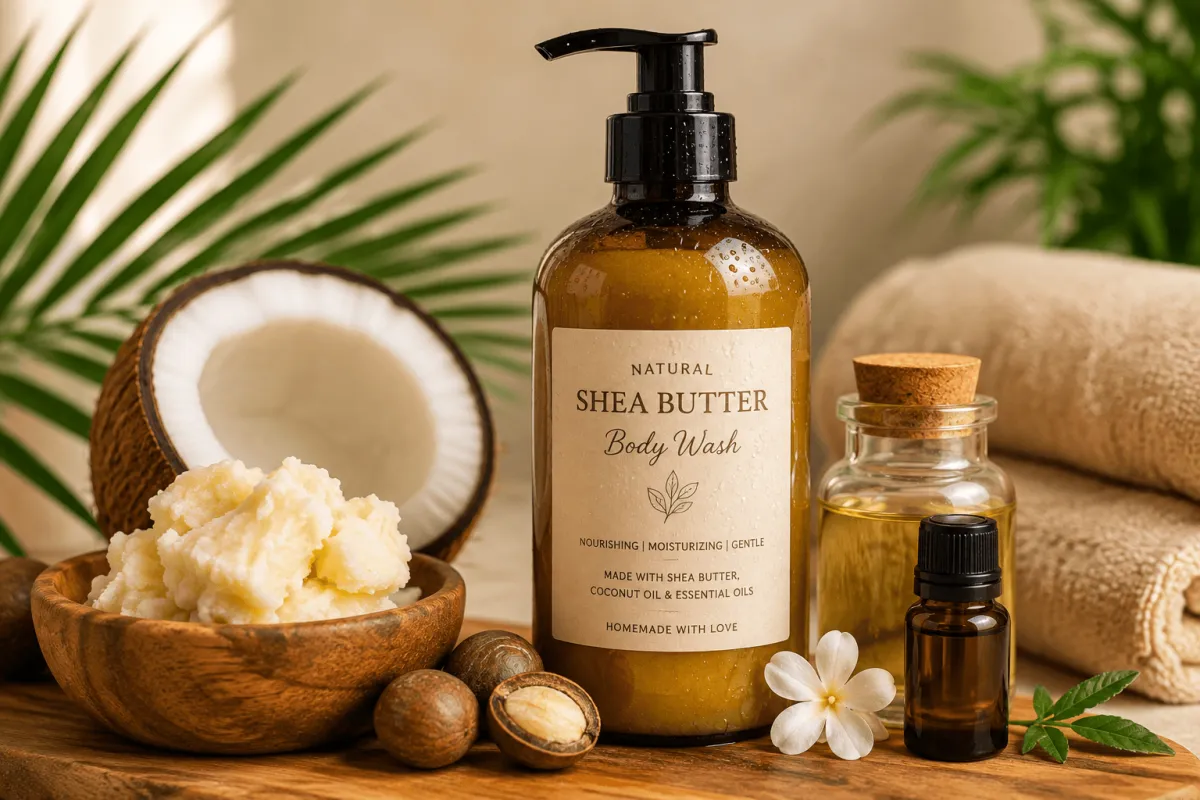
This recipe elevates the basic formula with shea butter and additional skin-loving ingredients. Furthermore, the resulting body wash feels noticeably more luxurious, leaves skin visibly moisturized, and commands premium retail prices.
Makes: 500ml
Ingredients by Weight:
Water Phase:
- Distilled water – 300g (60%)
- Vegetable Glycerine – 30g (6%)
- Aloe Vera Juice – 25g (5%)
Surfactant Phase:
- Cocamidopropyl Betaine – 120g (24%)
Oil and Butter Phase:
- Coconut Oil – 10g (2%)
- Natural Shea Butter – 5g (1%)
Cool Down Phase:
- Salt – 5g (1%)
- Preservative – 1g (0.5%)
- Essential oils – 25 drops
- Citric acid (pH adjustment)
Total: 500g
What Makes This Recipe Different:
Aloe vera juice adds additional soothing and conditioning benefits. Additionally, it provides natural humectant properties alongside glycerine, doubling the moisture-attracting power.
Coconut oil provides deeper skin conditioning. Furthermore, lauric acid in coconut oil has natural antibacterial properties that keep skin healthy.
Shea butter is the luxury differentiator. Small amounts of shea butter leave skin noticeably softer and more nourished after showering. Consequently, customers immediately feel the difference from commercial body wash.
Special Instructions for Recipe 2:
Incorporating shea butter and coconut oil into a surfactant base requires a specific technique. Follow these additional steps:
Before Step 3: Melt shea butter and coconut oil together until completely liquid. Then, add them directly to the Cocamidopropyl Betaine (not to the water). Specifically, mixing the oils with the surfactant first creates a pre-dispersed oil phase that incorporates smoothly into the water without separation.
Step 3 modification: Add the oil-surfactant mixture to the water and glycerine rather than plain surfactant. Everything else follows exactly as Recipe 1.
Why this technique matters: Adding oil directly to the water phase without this pre-mixing step causes the oil to separate. Consequently, you’d end up with an oily layer floating on top of your body wash.
Recipe 3: Antibacterial Natural Body Wash (Bonus Recipe!)
This specialized formula is perfect for the Nigerian climate where bacterial skin issues are common. Furthermore, it’s particularly popular among people who exercise regularly, have acne-prone skin, or work in environments that cause excessive sweating.
Makes: 500ml
Ingredients by Weight:
Water Phase:
- Distilled water – 320g (64%)
- Vegetable Glycerine – 20g (4%)
Surfactant Phase:
- Cocamidopropyl Betaine – 140g (28%)
Oil Phase:
- Sweet Almond Oil – 5g (1%)
Cool Down Phase:
- Salt – 5g (1%)
- Preservative – 1g (0.5%)
- Tea Tree Essential Oil – 20 drops (antibacterial)
- Peppermint Essential Oil – 10 drops (cooling)
- Eucalyptus Essential Oil – 8 drops (antimicrobial)
- Citric acid (pH adjustment)
Total: 500g
What Makes This Formula Special:
The antibacterial power comes entirely from the essential oil blend rather than harsh synthetic antimicrobial agents. Specifically:
Tea tree oil contains terpinen-4-ol, a compound with clinically proven antimicrobial activity against a wide range of bacteria and fungi that cause skin issues. Consequently, it’s the most effective natural antibacterial ingredient for body wash formulation.
Peppermint oil provides a cooling, refreshing sensation particularly appreciated in hot Nigerian weather. Furthermore, it has mild antimicrobial properties that complement tea tree oil’s action.
Eucalyptus oil adds additional antimicrobial coverage and creates that distinctive “clean” scent that customers associate with effective cleansing.
Follow Recipe 1 instructions exactly for this formula. The only difference is the essential oil blend used in the cool down phase.
Natural Body Wash for Different Nigerian Skin Types
For Dry Skin
Dry skin needs maximum moisture delivery during cleansing. Therefore, use Recipe 2 (luxury shea butter) as your primary formula. Additionally, increase glycerine to 35g and add an extra 5g of sweet almond oil. Furthermore, avoid using too much body wash per shower because over-cleansing strips the limited natural oils dry skin produces.
Application tip: Apply body wash to damp skin rather than soaking wet skin. The slightly less diluted contact time allows moisturizing ingredients to penetrate more effectively before rinsing.
For Oily Skin
Oily skin needs thorough cleansing without triggering rebound oil production. Consequently, use Recipe 3 (antibacterial) or Recipe 1 (basic) rather than the richer Recipe 2. Additionally, increase Cocamidopropyl Betaine by 10g and reduce water by 10g for slightly stronger cleansing. Furthermore, use tea tree and peppermint essential oils specifically for their sebum-regulating properties.
Application tip: Use lukewarm rather than hot water. Hot water stimulates sebum production and makes oily skin worse. Additionally, rinse thoroughly to prevent any surfactant residue that can cause breakouts.
For Sensitive Skin
Sensitive skin needs the gentlest possible formula. Therefore, replace 30% of Cocamidopropyl Betaine with Decyl Glucoside (an even milder surfactant) in Recipe 1. Additionally, use only lavender or chamomile essential oils and avoid citrus or spice oils that can irritate sensitive skin.
Application tip: Use your hands rather than a loofah or scrubbing cloth. The friction from physical scrubbing can trigger irritation on sensitive skin.
For Normal Skin
Lucky you! Any of the three recipes will work beautifully. However, Recipe 2 (luxury shea butter) provides the most enjoyable shower experience for everyday use. Additionally, rotate between the three recipes for variety.
For Combination Skin
Focus Recipe 3 (antibacterial) on oily areas like the chest and back. Meanwhile, use Recipe 2 (luxury) on drier areas like arms and legs. Consequently, you address different skin needs without compromising either area.
How to Use Natural Body Wash Correctly
Most people use body wash incorrectly, which reduces its effectiveness and can actually harm skin. Here’s the right technique.
The Right Amount
Commercial body wash is extremely concentrated with surfactants, which is why people use large amounts. Natural body wash with milder surfactants requires even less per use. Specifically, one pump or about a teaspoon is sufficient for your entire body. Using too much actually reduces lathering due to dilution effects.
Application Method
Apply natural body wash to a wet loofah, bath sponge, or your hands. Create lather by rubbing before applying to skin. Then, massage gently onto wet skin in circular motions. Furthermore, spend extra time on areas that need more cleansing (underarms, feet) without scrubbing aggressively on sensitive areas.
Water Temperature
Use warm rather than hot water. Specifically, hot water opens the skin barrier and allows more surfactant to penetrate. Consequently, this increases dryness and irritation. Warm water cleanses effectively without this additional barrier disruption.
Final Rinse
Rinse thoroughly with cool water as your final step. The cool water closes the skin barrier, reducing moisture loss after showering. Furthermore, any mild tingling from essential oils (especially peppermint or eucalyptus) is pleasant and normal.
After Showering
Apply your body moisturizer immediately after patting skin dry. Specifically, damp skin absorbs moisturizer more effectively than completely dry skin. Consequently, using your natural body wash and a quality moisturizer together provides dramatically better results than either product alone.
Troubleshooting Your Natural Body Wash
Problem: Body wash is too thin and watery
Why: Insufficient salt, too much water, or surfactant percentage is too low.
Fix: Add salt in 1g increments while stirring gently. Test consistency after each addition. Additionally, ensure you measured water accurately using a scale rather than volume measurements.
Problem: Body wash is thick but won’t lather
Why: Too much salt (past the peak of the salt curve), or pH is incorrect.
Fix: Add distilled water 10g at a time while stirring gently until the right consistency and lather return. Furthermore, recheck pH and adjust to 5.0-6.0 if needed.
Problem: Oil floating on top of body wash
Why: Too much oil added without proper technique, or oil wasn’t pre-mixed with surfactant (Recipe 2).
Fix: Reheat the formula slightly and mix vigorously. If it still separates, the oil percentage is too high for the surfactant concentration. Consequently, reduce oil by half in your next batch.
Problem: Body wash irritates skin
Why: pH is too high or too low, essential oil percentage is too high, or skin sensitivity to a specific ingredient.
Fix: Test pH immediately. Additionally, reduce essential oils to half the recommended amount. Furthermore, do a patch test with each individual ingredient to identify the specific irritant.
Problem: Body wash smells unpleasant after 2-3 weeks
Why: Insufficient preservative, contaminated equipment, or water contamination from use.
Fix: Ensure preservative is at the correct usage rate (0.5-1%). Additionally, always use a pump dispenser rather than opening the bottle directly to prevent water contamination during use.
Problem: Body wash is cloudy instead of clear
Why: Normal for formulas containing oils. Cloudiness doesn’t affect performance.
Fix: Nothing needed. Cloudy body wash is perfectly normal and effective. However, if you prefer clear body wash for aesthetic reasons, omit the oils entirely and rely solely on glycerine for moisturizing.
Packaging and Selling Your Natural Body Wash
Natural body wash is one of the best products for building a sustainable Nigerian beauty business. Here’s everything you need to know.
Container Options:
Pump bottles (250-500ml): Most professional appearance and most hygienic dispensing method. Consequently, these command the highest retail prices and look most impressive on product photos.
Squeeze bottles (250-500ml): Practical, affordable, and familiar to Nigerian consumers. Furthermore, they’re lightweight for delivery and shipping.
Refill pouches: An eco-friendly option gaining popularity in Nigerian markets. Additionally, offering refills at a discounted price encourages repeat purchases and customer loyalty.
Labeling Requirements:
Every label should include product name, full INCI ingredient list, net volume, manufacturing date, batch number, usage instructions, and your brand contact information. Furthermore, “Sulfate-Free” and “Paraben-Free” claims are powerful marketing tools for natural body wash that should be featured prominently.
Pricing Your Natural Body Wash:
Cost breakdown per 500ml bottle:
- Ingredients: ₦1,200-₦1,500
- Bottle and label: ₦400-₦600
- Total cost: ₦1,600-₦2,100
Recommended retail prices:
- Basic recipe: ₦3,000-₦4,000 per 500ml
- Luxury shea butter recipe: ₦4,000-₦5,500 per 500ml
- Antibacterial recipe: ₦3,500-₦4,500 per 500ml
- Sample/travel size (100ml): ₦1,000-₦1,500
Profit per bottle: ₦900-₦3,400 depending on recipe and positioning
Scale example: Sell 30 luxury shea butter bottles monthly at ₦5,000 each = ₦150,000 revenue, approximately ₦105,000 profit. That’s outstanding income for a few hours of production weekly!
Building Your Complete Natural Bath Collection:
With your natural shampoo, conditioner, body scrub, and now body wash recipes, you’re building a genuinely comprehensive natural bath and body collection. Consequently, customers can buy everything they need for their complete natural routine from you.
Your complete natural bath collection:
- Natural Shampoo (₦3,500)
- Natural Conditioner (₦4,500)
- Natural Body Wash (₦4,000)
- Natural Body Scrub (₦2,500)
- Natural Body Butter (₦4,000)
- Hair Growth Oil (₦3,500)
Complete collection bundle price: ₦20,000 (saving ₦2,000)
Customers who buy the complete collection represent your highest-value customers. Moreover, they become brand advocates who recommend your products to everyone they know.
Marketing Your Natural Body Wash:
Position it as “Nigeria’s answer to expensive imported natural body wash.” Additionally, demonstrate ingredient transparency by posting educational content about what’s NOT in your product (no SLS, no parabens, no synthetic fragrances). Furthermore, create comparison content showing your price versus imported natural brands.
Your Action Plan: Make Your First Batch This Weekend
You now have three complete natural body wash recipes covering every Nigerian skin need and budget.
First, decide which recipe suits your skin type and goals. Recipe 1 is ideal for beginners and all skin types. Recipe 2 is perfect for dry skin or premium product positioning. Recipe 3 is excellent for active people and oily skin.
Second, gather your ingredients from a quality supplier. Specifically, quality Cocamidopropyl Betaine and Vegetable Glycerine are your two most important purchases.
Third, invest in a digital kitchen scale and pH strips. These two affordable tools are the difference between professional results and frustrating failures.
Fourth, start with Recipe 1 to master the technique before attempting Recipe 2 or 3.
Finally, take before and after photos of your skin after switching from commercial to natural body wash. The difference in skin hydration and softness will genuinely surprise you.
Ready to start? Get your quality ingredients:
- Cocamidopropyl Betaine (Coco Betaine) – Your essential cleansing ingredient
- Vegetable Glycerine – Daily moisture attraction for all recipes
- Coconut Oil – Nourishing conditioning ingredient
- Sweet Almond Oil – Lightweight skin softener for all recipes
- Natural Shea Butter – Luxury conditioning for Recipe 2
Have you tried making natural body wash at home before? What ingredients worked best for your skin? Share your experience in the comments below. Our community of 5,000+ Nigerian beauty enthusiasts would love to hear from you and learn from your journey!